
Reading Time: 8 minutes
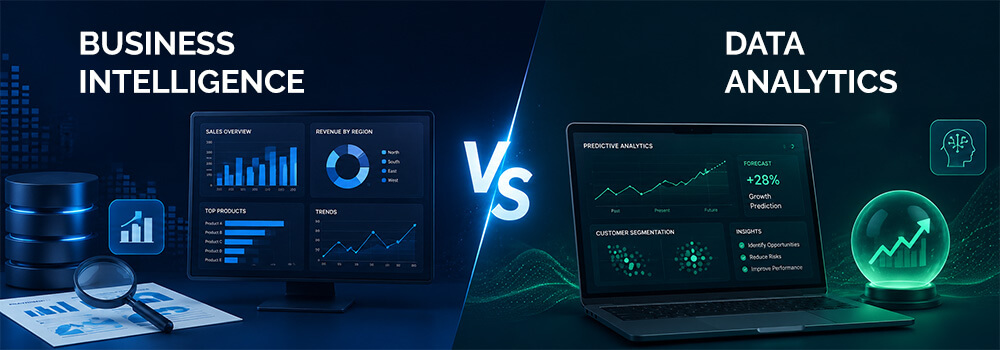
Business Intelligence vs Data Analytics: What's the Real Difference?
If you have sat in a leadership meeting where everyone agrees the organization needs “better data insights,” but no one is quite aligned on what that actually means, you already know how tangled these two terms can get. Business intelligence and data analytics are often used as if they mean the same thing. They do not, and the difference matters a lot more than semantics once you are the one responsible for architecture decisions, tool procurement, or reporting outcomes to the board.
For IT managers, CTOs, CIOs, DevOps engineers, and SaaS founders, understanding this distinction is practical, not academic. It shapes how you design data infrastructure, which platforms you invest in, how you staff your teams, and how quickly your organization can move from understanding performance to making better decisions.
This blog breaks down business intelligence and data analytics in plain language, explains how they work together, and offers a practical perspective on building a technology stack that supports both.
A practical way to think about it: BI gives teams a trusted operating view of the business, while analytics helps them ask deeper questions, test assumptions, and plan the next move. Most growing organizations need both, but they do not always need to build both at the same pace.
What is Business Intelligence?
Business intelligence, commonly shortened to BI, refers to the processes, tools, and technologies used to collect, organize, analyze, and present business data in a way that supports decision making. BI is often strongest at backward and present-looking questions: What were our sales last quarter? Which region is underperforming? How many support tickets did we close this week?
BI tools typically pull data from multiple systems, such as ERP platforms, CRM software, financial systems, and product or customer data sources, and consolidate it into dashboards, reports, and scorecards. In many environments, that data is structured and curated before it reaches business users, even when the original sources include semi-structured or unstructured information. The goal is to give business leaders a clear, consistent view of performance so they can make informed operational decisions without digging through spreadsheets.
Key characteristics of business intelligence include:
- Focus on descriptive reporting: what has happened and what is happening now
- Use of dashboards, KPIs, and visualizations for quick consumption
- Reliance on structured, often historical business data
- Designed for a broad audience, including executives and department heads who may not be technical
Common BI platforms include tools like Power BI, Tableau, and Looker, which are widely adopted across mid-market and enterprise organizations because they translate complex datasets into digestible visuals.
What is Data Analytics?
Data analytics is a broader discipline for examining data with statistical methods, computational techniques, and domain context to uncover patterns, relationships, explanations, and predictions. While BI is often used to monitor what happened and what is happening now, data analytics is often used to understand why it happened, what is likely to happen next, and which actions may produce better outcomes.
Data analytics is typically broken into four types:
- Descriptive analytics: Summarizes historical data, similar to BI reporting
- Diagnostic analytics: Investigates the root causes behind trends or anomalies
- Predictive analytics: Uses statistical models to forecast future outcomes
- Prescriptive analytics: Recommends specific actions based on predicted outcomes
Unlike BI, data analytics often work with both structured and unstructured data, including logs, sensor data, customer behavior data, and text. It relies heavily on data science techniques, statistical modeling, and increasingly machine learning.
Data analytics may be performed by data scientists, data engineers, analysts, analytics engineers, or technically fluent business teams, depending on the organization’s maturity and toolset. The output is not always a polished dashboard. It might be a model, a forecast, a notebook, a data product, or a technical report intended for specialized teams before it is translated into business language.
Business Intelligence vs Data Analytics: The Core Differences
While the two disciplines overlap, especially at the descriptive level, several distinctions stand out:
Purpose BI is built for monitoring and reporting on business performance. Data analytics is built for deeper investigation, forecasting, and strategic decision support.
Timeframe BI generally looks backward and at the present. Data analytics, particularly predictive and prescriptive analytics, looks forward.
Data type BI relies mostly on structured, curated data sources. Data analytics can incorporate unstructured and semi-structured data such as text, images, or sensor output.
Audience BI dashboards are designed for business users across departments. Data analytics outputs are often consumed by technical teams, data scientists, and specialized decision makers before being translated into business language.
Tools and skill sets BI relies on visualization, reporting, semantic modeling, and governance capabilities that range from self-service tools to enterprise-scale platforms. Data analytics often requires stronger statistical, programming, experimentation, and machine learning skills, especially when the work moves beyond reporting into forecasting, optimization, or model development.
Complexity BI answers are usually straightforward once the data pipeline is built. Data analytics can involve iterative modeling, testing, and refinement before conclusions are reliable.
Why This Distinction Matters for Infrastructure and Technology Teams
For CTOs, CIOs, and infrastructure leaders, the BI versus data analytics conversation is not just theoretical. It directly influences architecture and platform decisions.
Data pipeline design BI systems typically depend on well-structured data warehouses with clean, consistent schemas. Data analytics workloads, especially those involving machine learning, often require more flexible data lakes or lakehouse architectures capable of handling varied data formats and larger volumes.
Cloud infrastructure planning Predictive and prescriptive analytics workloads tend to be compute-intensive, particularly during model training. This has implications for cloud resource allocation, autoscaling policies, and cost management compared to the relatively predictable resource needs of BI reporting.
Security and governance Because data analytics often draws from a wider range of data sources, including customer behavioral data, governance, access control, and compliance considerations become more complex than in a typical BI environment.
Team structure Organizations sometimes assume one data team can handle both BI reporting and advanced analytics. In practice, these are different skill sets. BI often falls under business analysts or IT reporting teams, while data analytics increasingly requires dedicated data engineers and data scientists.
Tool integration Many organizations now aim for a unified stack where BI dashboards sit on top of the same data infrastructure that feeds analytics models. This requires careful planning around ETL processes, data quality standards, and system interoperability, especially for SaaS companies managing multiple product data streams.
How SaaS Companies Can Benefit from Both
For SaaS product companies and mid-market software businesses, the combination of BI and data analytics can be a genuine competitive advantage.
BI dashboards help product and operations teams monitor usage metrics, churn rates, support volumes, and revenue trends in near real time. This supports faster operational decisions and clearer internal reporting.
Data analytics, on the other hand, allows SaaS companies to go further. Predictive models can flag customers at risk of churning before it happens. Usage pattern analysis can inform product roadmap decisions. Prescriptive models can even recommend personalized in-app experiences or pricing strategies based on customer segments.
The organizations that get the most value are those that treat BI and data analytics as complementary layers rather than competing priorities. BI keeps the business informed daily. Data analytics helps the business plan strategically and adapt proactively.
Building the Right Foundation
None of this works without solid infrastructure underneath it. Reliable BI and data analytics both depend on:
- Clean, well-governed data pipelines
- Scalable cloud or hybrid infrastructure that can handle both steady reporting loads and burst compute demands for modeling
- Strong data security and compliance controls
- Integration across business systems so data does not remain siloed in disconnected platforms
- Skilled teams or managed IT partners who understand both the reporting side and the technical analytics side
This is where many mid-market companies struggle. Building and maintaining this kind of infrastructure internally requires ongoing investment in tools, cloud architecture, and specialized talent. This is also why many organizations turn to managed IT services and infrastructure partners to design, implement, and maintain systems that support both BI and advanced analytics without overextending internal teams.
Conclusion: Looking Ahead
Business intelligence and data analytics are not competing disciplines. They are two layers of the same data strategy, each serving a different purpose. BI keeps organizations informed about current performance. Data analytics helps organizations understand deeper patterns and prepare for what comes next.
As cloud computing, automation, and AI-driven tools continue to mature, the line between BI and data analytics will likely blur further. Modern BI platforms are increasingly embedding predictive features, while data analytics tools are becoming more accessible to non-technical users through natural language interfaces and automated insights. Organizations that build flexible, well-governed data infrastructure now will be better positioned to take advantage of these advances as they arrive.
For IT leaders, CTOs, and SaaS businesses, the priority is not choosing between business intelligence and data analytics. It is building a secure, scalable, and well-governed infrastructure strategy that supports both, so your organization can monitor what is happening today, understand what is likely to happen tomorrow, and act with confidence.