
Reading Time: 9 minutes

Table of Content
GEO vs SEO: What's the Difference and Why Does It Matter?
- November 3, 2026
- Tarika Group
- Search Engine Optimization
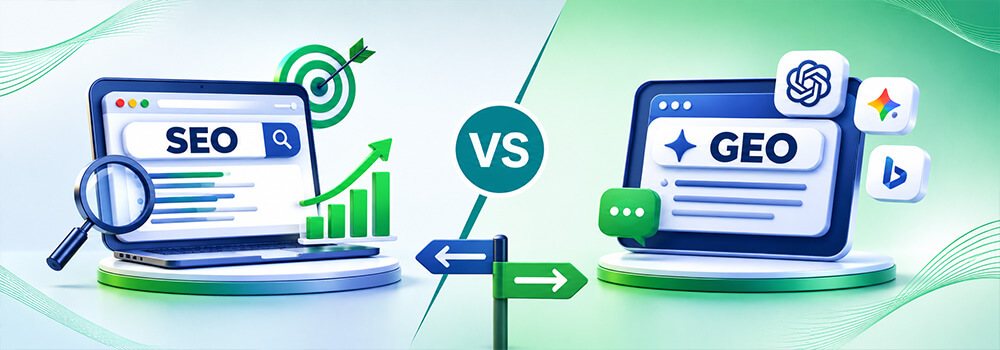
For two decades, getting found online meant one thing: ranking on a page of blue links. IT managers, CTOs, and SaaS founders learned the rules of search engine optimization (SEO), invested in content, and measured success by position and clicks.
That model is changing. Buyers now ask conversational questions to AI assistants and generative search tools, and they receive a synthesized answer instead of a list of websites. If your brand is not part of that answer, you may be invisible to a growing share of your audience, even when your traditional rankings look healthy.
Generative engine optimization, or GEO, comes into play here. In this guide, Tarika Group explains GEO vs SEO in plain terms, shows where the two overlap, and outlines practical steps for technology teams that want to stay visible in both classic and AI-driven search.
What Is SEO?
Search engine optimization (SEO) is the practice of improving a website so that it ranks higher in traditional search results. The goal is to earn organic traffic from people who type queries into a search engine and click a result.
A solid SEO program typically covers four areas:
- On-page SEO: Title tags, headings, meta descriptions, internal links, and keyword-aligned content.
- Technical SEO: Site speed, mobile responsiveness, crawlability, indexing, XML sitemaps, and secure HTTPS delivery.
- Content SEO: Helpful, well-organized pages that match search intent, from informational guides to commercial comparison pages.
- Off-page SEO: Backlinks and brand mentions from reputable websites.
SEO is built around a ranked list. Success is measured by keyword rankings, organic sessions, click-through rate, and conversions that follow a visit to your site.
What Is GEO?
Generative engine optimization is the practice of shaping your content so that AI-powered search tools can understand it, trust it, and include it in their generated responses. These tools rely on large language models (LLMs) to read, summarize, and combine information from many sources into a single answer.
With GEO, the goal shifts. Instead of asking, “How do we rank first?” the question becomes, “How do we become a cited, referenced, or recommended source inside the answer?”
GEO is sometimes discussed alongside related terms such as AI search optimization, LLM optimization, and answer engine optimization (AEO). While the labels vary, they point to the same core idea: make your expertise easy for machines to find, interpret, and reuse accurately.
GEO vs SEO: The Core Differences
Both disciplines aim to connect your expertise with people who need it. The way that connection occurs makes a difference.
1. The Output Format
SEO targets a results page with multiple links. GEO targets a single, conversational response that may mention a handful of sources or none at all. In the first case, users choose where to click. In the second, the AI chooses what to present.
2. How Success Is Measured
SEO relies on rankings, impressions, and clicks. GEO focuses on whether your brand, product, or content appears within AI-generated answers, how it is described, and whether the description is accurate. Visibility is often about mentions and citations rather than traffic alone.
3. Query Style
Traditional search often uses short keyword phrases such as “managed IT services provider.” Generative search invites full questions, such as “What should a mid-market SaaS company look for in a managed cloud services partner?” Longer, more detailed, multi-part queries must be directly addressed in GEO content.
4. Content Structure
SEO content is organized so crawlers can index it and readers can scan it. GEO content must also be easy to extract. AI systems may extract accurate claims from your pages with the use of clear definitions, succinct answer blocks, labeled sections, and consistent terminology.
5. Authority Signals
SEO leans heavily on backlinks and domain authority. GEO adds a stronger emphasis on entity clarity, meaning how consistently your brand, services, and expertise are described across your website and the wider web. Clear authorship, documented experience, and reliable references help build that consistency.
Quick Comparison
| Factor | SEO | GEO |
|---|---|---|
| Primary goal | Rank in search results | Be included in AI-generated answers |
| Main surface | Search results page | AI assistants and generative search |
| Success signals | Rankings, clicks, conversions | Mentions, citations, answer accuracy |
| Query style | Short keywords | Conversational questions |
| Content focus | Keyword relevance and links | Clarity, structure, and entity trust |
Where GEO and SEO Overlap
GEO does not replace SEO. The two work together, and strong SEO is often the foundation that makes GEO possible.
AI search tools frequently draw from content that is already crawlable, indexed, and well structured. A site that loads quickly, uses clean architecture, and publishes authoritative pages gives AI systems better material to work with. Several practices serve both goals:
- Publishing unique, well-written content that completely addresses a query.
- Using descriptive headings and a logical page hierarchy.
- Putting structured data and schema markup into practice.
- Maintaining technical health, including secure hosting and fast page delivery.
- Demonstrating experience, expertise, authoritativeness, and trustworthiness (E-E-A-T) through author bios and transparent company information.
Think of SEO as building the road and GEO as making sure your destination appears on the map that AI tools use.
Why GEO Matters for Technology Leaders
If you lead IT, infrastructure, or product teams, your buying journey is research-heavy. You compare vendors, evaluate architectures, and look for proof that a partner understands your environment. Increasingly, that research starts with an AI assistant.
Here is why GEO deserves a place on your roadmap.
Shorter paths to shortlists. When an AI tool summarizes the best approaches to cloud migration, cybersecurity posture, or DevOps automation, the brands included in that summary often shape the shortlist before a buyer ever visits a website.
Brand accuracy. AI systems describe companies based on the information they can find. If your service pages are vague or inconsistent, the generated description of your business may be incomplete or wrong. GEO helps you control the narrative.
Complex purchase support. Technology buying decisions involve multiple stakeholders. Clear, well-structured content helps each stakeholder, from a CTO evaluating architecture to an IT manager comparing support models, find reliable answers quickly.
How to Optimize for Both GEO and SEO
You do not need two separate strategies. A cohesive strategy can increase visibility in both AI-driven and conventional search. Start with these steps.
Write Direct Answers First
Open each major section with a short, plain-language answer to the question in the heading. Add context, examples, and supporting details after that. This format serves featured snippets, voice search, and AI summaries alike.
Use Conversational, Question-Based Headings
Headings that mirror real questions, such as “What is zero trust security?” or “How does managed cloud support work?”, align with how people phrase prompts to AI tools.
Add Structured Data
Schema markup for organizations, services, FAQs, articles, and authors gives machines explicit context. It makes it clearer who you are and what you can do.
Strengthen Entity Consistency
Describe your company, services, and expertise using the same terminology across your website, social profiles, directory listings, and partner pages. Consistency helps AI systems form a reliable understanding of your brand.
Create Depth, Not Just Volume
Thin sites produced for a single keyword are typically less helpful than comprehensive resources that address a subject from multiple perspectives. Build topic clusters around core areas such as managed IT services, cloud infrastructure, cybersecurity, and SaaS application management.
Keep Content Fresh and Accurate
Review technical content regularly. Outdated guidance on tools, configurations, or compliance can weaken trust with both readers and AI systems.
Make Authorship Visible
Attribute content to named experts with clear credentials. For technical audiences, evidence of hands-on experience carries real weight.
Monitor AI Visibility
Periodically ask AI assistants the questions your buyers ask and review how your brand appears. Note which pages are referenced, where descriptions fall short, and which topics need stronger coverage.
Common Misconceptions About GEO vs SEO
“GEO makes SEO obsolete.” It does not. Traditional search remains a major discovery channel, and the technical foundation of SEO supports GEO.
“GEO is just keyword stuffing for AI.” Quite the opposite. Generative systems favor clear, natural, well-organized writing. Repetition of forced keywords is detrimental to you.
“In AI search, only big brands can succeed.” By generating targeted, knowledgeable material in a certain niche and clearly presenting it, smaller and mid-market businesses may compete.
How Tarika Group Can Help
Tarika Group brings together deep experience in managed IT services, cloud computing, cybersecurity, and enterprise and SaaS application ecosystems. That technical background matters for content strategy, because credible GEO and SEO depend on accurate, experience-backed information about the technologies your buyers care about.
Whether you are modernizing your infrastructure, scaling a SaaS platform, or planning how your technical expertise reaches decision makers, a well-structured digital presence supports every stage of the journey. Our team can help you align your technology story with the way modern search tools discover and present information.
Conclusion
The debate between GEO and SEO is not about picking one over the other. SEO helps people find your pages. GEO helps AI tools understand, trust, and present your expertise. Together, they give your brand a stronger chance of being discovered at every point where buyers look for answers.
For IT managers, CTOs, cloud architects, and SaaS leaders, the takeaway is practical: write clearly, structure content for both humans and machines, keep your information consistent and current, and treat search visibility as part of your broader technology strategy.
Ready to strengthen your digital presence with a partner that understands technology from the inside? Connect with Tarika Group to start the conversation.
Frequently Asked Questions
What is the main difference between GEO and SEO?
SEO improves how your pages rank in traditional search results, while GEO improves how often and how accurately your content is used in AI-generated answers. SEO aims for clicks from a results page. GEO aims for inclusion inside the answer itself.
Does GEO replace SEO?
No. GEO builds on SEO. Crawlable, fast, well-structured, authoritative pages give AI systems reliable material to draw from, so strong SEO fundamentals remain essential.
What does GEO stand for?
GEO stands for generative engine optimization. It refers to optimizing content for AI-powered tools that generate responses using large language models.
How is GEO different from AEO?
Answer engine optimization (AEO) focuses on structuring content so it can be returned as a direct answer, such as in featured snippets or voice assistants. GEO extends that idea to generative AI tools that combine information from multiple sources. In practice, the two share many tactics, including concise answers and structured data.
Does schema markup help with generative engine optimization?
Yes. Schema markup gives machines explicit information about your organization, services, authors, and FAQs. This clarity helps both traditional search engines and AI systems interpret your content correctly.
Can small or mid-market companies compete in AI search?
Yes. Focused expertise, clear writing, and well-organized content allow mid-market businesses to be referenced alongside larger competitors, especially within a specific niche.