
Reading Time: 10 minutes

Table of Content
- 5 Quick Cybersecurity Wins Every Business Can Implement This Month
- Why Quick Wins Matter in Cybersecurity
- Win 1: Enforce Multi-Factor Authentication Everywhere It Matters
- Win 2: Tighten Patch and Update Management
- Win 3: Review and Reduce Access Privileges
- Win 4: Verify Backups and Practice Recovery
- Win 5: Run Focused Security Awareness Training and Phishing Simulations
- How an MSP Can Help You Move Faster
- A Simple 30-Day Plan
5 Quick Cybersecurity Wins Every Business Can Implement This Month
- November 16, 2026
- Tarika Group
- Cyber Security
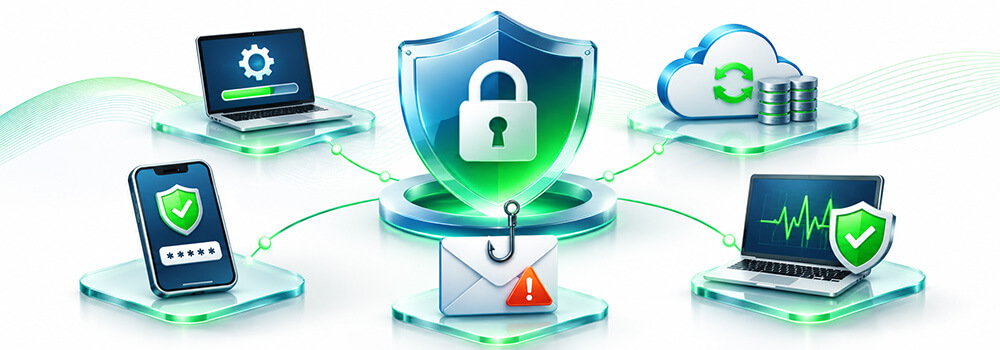
Cybersecurity projects often sound like long, expensive undertakings. Roadmaps stretch across quarters, budgets need approval, and daily operations leave little room for another initiative. As a result, many organizations postpone basic protections while waiting for the perfect moment to act.
The good news is that meaningful risk reduction does not always require a major overhaul. Several high-impact controls can be put in place within a few weeks, often using tools your organization already owns. For IT managers, CTOs, CIOs, DevOps engineers, and cloud architects, these quick wins create a stronger baseline while larger strategic work continues in the background.
At Tarika Group, we work with growing companies that rely on Managed IT and IT Services to keep systems secure, available, and compliant. This guide outlines five practical steps that any business can complete this month, whether you run an internal infrastructure team, depend on a Managed Service Provider (MSP), or combine both approaches.
Why Quick Wins Matter in Cybersecurity
A quick win is a security improvement that is low in effort, clear in scope, and meaningful in impact. It does not replace a full security program. Instead, it closes common gaps that attackers routinely look for, such as weak sign-in methods, unpatched software, and untested backups.
Quick wins also build momentum. When a team completes visible improvements within thirty days, it becomes easier to gain support for deeper work such as zero trust architecture, endpoint detection and response, or a formal compliance program. They also give leadership something concrete to point to when asked how the organization is managing cyber risk.
The five wins below are ordered so that each one supports the next. Start at the top and work down, or assign them to different owners and run them in parallel.
- User onboarding and offboarding across SaaS applications
- Password resets and access requests
- Patch deployment for servers, endpoints, and virtual machines
- Backup verification and restore testing
- Log collection and routine report generation
Win 1: Enforce Multi-Factor Authentication Everywhere It Matters
Passwords alone are a fragile control. They can be guessed, reused across services, or captured through phishing. Multi-factor authentication (MFA) adds a second proof of identity, which means a stolen password is no longer enough to access an account.
Where to Start
Prioritize the accounts that would cause the most damage if compromised:
- Administrator accounts in identity providers, cloud consoles, and hypervisors
- Email and collaboration platforms
- Remote access tools, including VPN and remote desktop gateways
- Source code repositories and CI/CD pipelines
- Finance, payroll, and customer data applications
Practical Tips
Choose authenticator apps or security keys over SMS codes whenever your platforms support them. Turn on conditional access policies so that sign-ins from unfamiliar locations or unmanaged devices trigger additional checks. Document a clear recovery process so that employees who lose a device are not locked out for days.
For DevOps teams, do not overlook service accounts and API tokens. These non-human identities should use short-lived credentials, scoped permissions, and secrets management rather than static keys stored in code.
Win 2: Tighten Patch and Update Management
Attackers frequently take advantage of known vulnerabilities for which fixes already exist. A consistent patching routine removes many of these easy entry points and is one of the most cost-effective actions an IT team can take.
Build a Simple, Repeatable Process
You do not need a complex framework to begin. Start with these steps:
- Inventory your assets. List servers, endpoints, network devices, virtual machines, containers, and SaaS applications. You cannot protect what you cannot see.
- Rank by exposure. Internet-facing systems and those holding sensitive data should be patched first.
- Set a schedule. Choose a regular maintenance window and communicate it to stakeholders in advance.
- Test before broad rollout. Apply updates to a small group of systems first to catch compatibility problems.
- Verify and report. Confirm that patches installed successfully and track exceptions.
Do Not Forget Third-Party Software and Images
Operating systems are only part of the picture. Browsers, productivity suites, remote management agents, and open-source libraries all need attention. In cloud and container environments, rebuild base images on a regular basis so that fixes are carried into new deployments rather than patched in place and lost on the next release.
If your internal team is stretched thin, this is an area where Small Business IT Support or a co-managed model can relieve pressure. An MSP can automate patch deployment, monitor for failures, and provide reporting that supports audit requirements.
Win 3: Review and Reduce Access Privileges
Over time, access tends to accumulate. Employees change roles, contractors finish projects, and temporary permissions become permanent. Each unnecessary permission expands the damage an attacker or careless insider could cause.
Apply the Principle of Least Privilege
Least privilege means that every user, application, and system receives only the access required to perform its function. A focused access review this month can accomplish a great deal:
- Remove accounts belonging to former employees and completed contractors
- Identify users with administrator rights and confirm the need for each one
- Separate daily-use accounts from privileged accounts
- Review shared accounts and replace them with named, traceable identities
- Audit external sharing settings in file storage and collaboration tools
Make It Ongoing
Once the first review is complete, schedule recurring access reviews and tie them to HR events such as onboarding, role changes, and offboarding. Automating these workflows through your identity platform reduces the chance of missed steps. This practice also supports Compliance efforts, since many frameworks expect organizations to demonstrate who has access to what and why.
Win 4: Verify Backups and Practice Recovery
Backups are only valuable if they can be restored when needed. Many organizations discover problems with their backup strategy at the worst possible moment, during an outage or a ransomware incident.
Check the Fundamentals
A widely used guideline is the 3-2-1 approach: keep three copies of important data, store them on two different types of platforms, and keep one copy offsite or in an isolated location. Add immutability or offline protection to at least one copy so that attackers who gain access to your network cannot delete or encrypt it.
Run a Restore Test
This month, select a representative system and perform a complete restore in a test environment. Record how long it takes, what steps were required, and what went wrong. Then answer these questions:
- Does the recovery time meet what the business can tolerate?
- Are backup credentials stored separately from your primary directory?
- Is configuration data, such as infrastructure-as-code repositories and SaaS settings, included?
- Does your team know who makes the decisions during a recovery event?
SaaS platforms deserve special attention. Many business owners assume that cloud applications automatically protect every version of every record, but responsibility is often shared between the provider and the customer. Review the terms of each platform and consider a dedicated backup solution for critical SaaS data.
Win 5: Run Focused Security Awareness Training and Phishing Simulations
Technology controls work best when employees understand why they exist. Phishing, credential theft, and social engineering all target people rather than systems, so a short, well-designed awareness effort can strengthen your defenses at modest cost.
Keep It Short and Relevant
Long annual presentations are easy to forget. Instead, deliver brief sessions focused on real scenarios your teams are likely to face:
- Recognizing suspicious email requests for payments or credentials
- Verifying unusual requests through a second channel
- Handling sensitive data in chat and file sharing tools
- Reporting a suspected incident quickly without fear of blame
Make Reporting Easy
Provide a simple button or a dedicated mailbox for reporting suspicious messages, and acknowledge each report. A culture where people feel comfortable raising concerns helps your IT Support team detect threats earlier and respond faster.
For technical staff, add role-specific content. Developers benefit from guidance on secure coding and secrets handling, while cloud architects can review misconfiguration risks in storage, networking, and identity settings.
How an MSP Can Help You Move Faster
Completing all five wins in a single month is realistic when responsibilities are clear and tools are in place. Still, many internal teams juggle projects, support requests, and on-call duties, which makes dedicated security work hard to prioritize.
A Managed Service Provider can fill that gap. Through MSP services, organizations gain access to experienced engineers, standardized processes, and around-the-clock monitoring without expanding headcount. Typical offerings include:
- Managed IT operations, including patching, monitoring, and asset management
- Help desk and IT Support for employees across locations
- Identity and access management guidance
- Backup and disaster recovery planning and testing
- Security awareness programs and policy development
- Compliance readiness support aligned with the frameworks your customers expect
For mid-market SaaS companies and product teams, this model allows internal engineers to stay focused on building and scaling while a trusted partner maintains the security foundation. Tarika Group works alongside in-house teams as a co-managed partner or as a full provider of Managed IT, depending on what fits your environment.
A Simple 30-Day Plan
If you want a clear path, use this timeline as a starting point:
| Week | Focus | Outcome |
|---|---|---|
| Week 1 | Enable MFA for administrators, email, and remote access | Strong identity protection on critical accounts |
| Week 2 | Build an asset inventory and launch a patch cycle | Visibility and a repeatable update routine |
| Week 3 | Complete an access review and remove excess privileges | Reduced exposure from unnecessary permissions |
| Week 4 | Test a restore and deliver awareness training | Proven recovery and a more alert workforce |
Assign an owner to each task, set a completion date, and report progress to leadership. Small, visible milestones keep the effort on track.
Conclusion
Strong cybersecurity is built through steady, practical improvements rather than one dramatic project. Enforcing MFA, keeping systems patched, trimming access, proving that backups work, and training employees can all be accomplished within a month, and together they create a more resilient foundation for everything that follows.
If your team needs support turning these ideas into action, Tarika Group can help. Our specialists provide Managed IT, IT Support, cybersecurity guidance, and Compliance assistance tailored to growing businesses and technology teams. Contact Tarika Group to schedule a consultation and start building a safer environment this month.
Frequently Asked Questions
What is the first cybersecurity step a business should take?
Enabling multi-factor authentication on administrator, email, and remote access accounts is a strong first step. It addresses account takeover, one of the most common ways attackers gain entry, and can usually be completed quickly with existing platforms.
Can small businesses improve cybersecurity without a large budget?
Yes. Many effective controls, including MFA, patch routines, access reviews, and employee training, rely more on process and discipline than on expensive tools. Small Business IT Support from an experienced provider can also spread the cost of expertise across many clients.
What does a managed service provider do for cybersecurity?
An MSP monitors systems, applies updates, manages backups, supports users, and helps design and maintain security policies. Many providers also assist with Compliance preparation and incident response planning, so your organization is not handling these tasks alone.
How often should we test our backups?
Test restores at least quarterly for critical systems, and after any major change to your infrastructure or backup platform. Frequent testing reveals gaps in time to correct them before a real incident.
How does cybersecurity connect to compliance?
Compliance frameworks generally require specific safeguards, such as access controls, logging, patching, and data protection. Implementing the quick wins in this article creates documented, repeatable practices that make audits easier to prepare for.
Should we choose in-house IT, an MSP, or a co-managed model?
The right answer depends on your team size, technical depth, and growth plans. In-house teams offer close familiarity with your systems, while MSP services add breadth, coverage, and scalability. A co-managed arrangement combines both and is common among mid-market SaaS organizations.